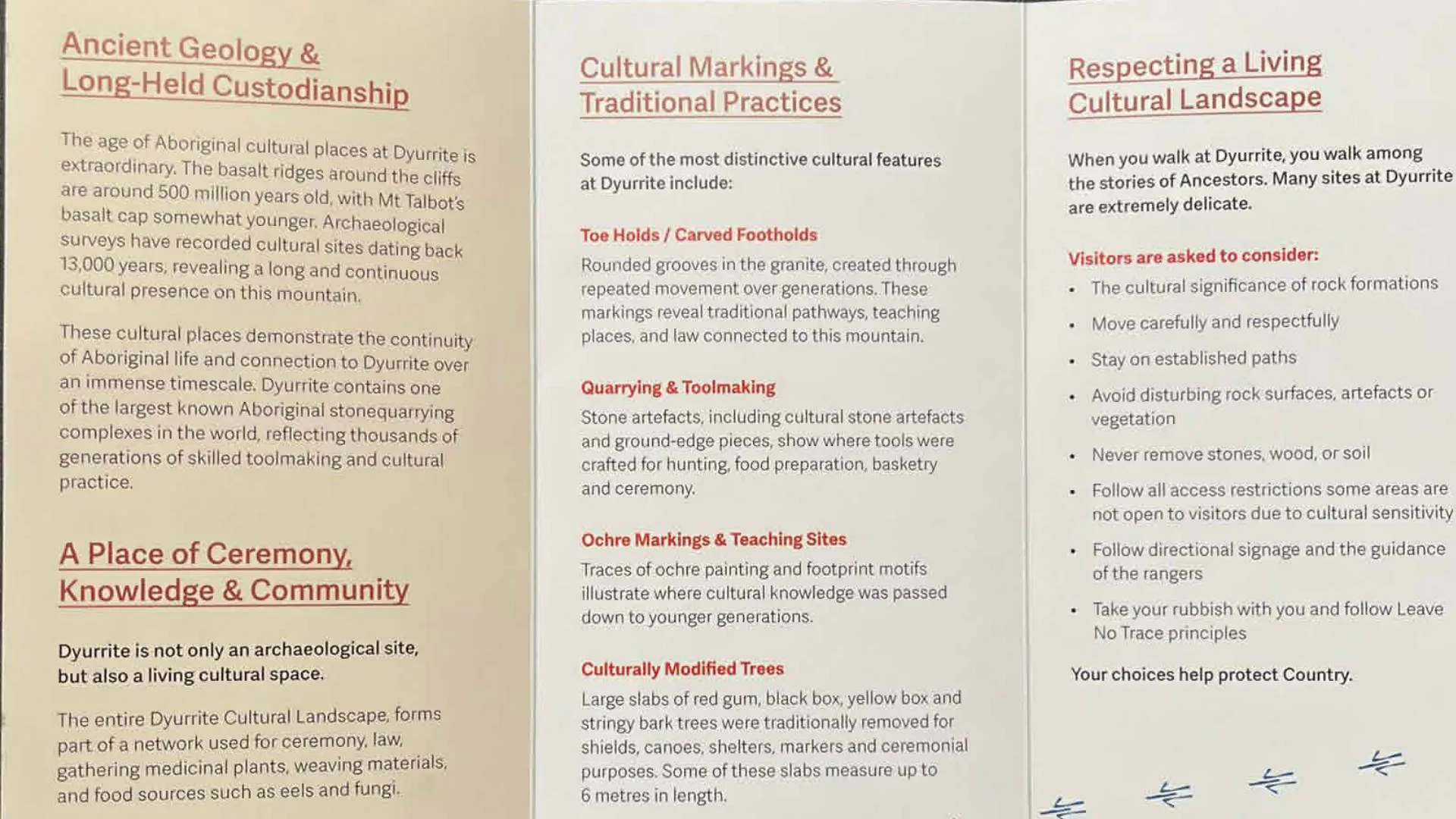
Corrugations are the thing that breaks vehicles in the outback. Not rocks, not mud, not water crossings. Corrugations. They loosen bolts, crack brackets, kill shocks, split water tanks and shake wiring looms apart. They do it slowly, over thousands of kilometres, and most people never work out what actually caused the failure.
There is also more bad information circulating about corrugations than almost any other topic in four-wheel driving.
I want to be upfront about how I got to my view on this. I am not an engineer. I worked it out by driving, over about 100,000 km of corrugation, and I only went looking for the technical explanation afterwards, because I wanted to know whether what I was feeling was real or whether I was kidding myself. The experience came first. The physics came second and it backed up what I'd found.
So I'll give you both, in that order.
If you want this topic covered properly for a full desert crossing — and for general outback driving beyond the Simpson — start with the Simpson Desert guide on this site, and get the Simpson Desert Travel Guide. It covers corrugation in depth, and a lot more besides.
What I found by driving
The clearest evidence I have is a broken camera mount.
I had GoPro brackets mounted to the bull bar. At slow speed on corrugation I could watch the mount shaking violently and continuously, and after enough of it the bracket cracked and broke off. I replaced it and ran the same sort of track faster. The shaking settled right down and that bracket went on to survive thousands of kilometres.
Same bracket, same track, same vehicle. The only thing I changed was speed. If going faster simply meant more force, that bracket should have died sooner, not lasted longer.
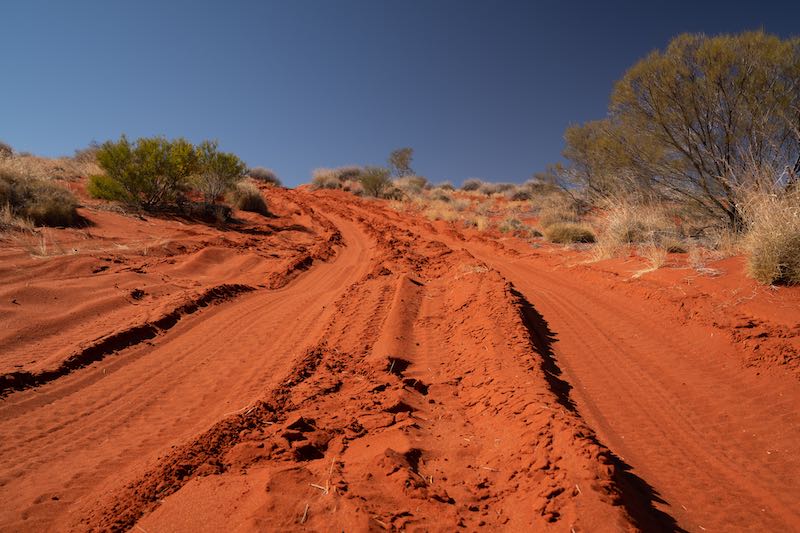
The longer version of the same evidence is the LandCruiser itself. It is 26 years old. I've owned it eight years and put 300,000 km of remote touring through it, and I'd estimate around 100,000 km of that has been corrugation, driven the way I'm describing here. It has needed very few repairs beyond routine maintenance. That is not the outcome you would expect if I'd spent eight years hammering it.
What I've settled on is this. There is a band, roughly 30 to 50 km/h, where everything shakes hard and the noise is genuinely unpleasant. Above that, on most outback corrugation, my vehicle finds a speed somewhere between 70 and 90 where it settles. You can feel the moment you hit it. The hammering turns into a hum and the whole car goes quiet.
That is the bit people argue with. So I went and looked up why it happens.
What corrugations actually are
Corrugations are not made by bad driving. They are what loose material does under a rolling wheel, and they will form whether anyone likes it or not.
When a wheel rolls over sand or gravel above a certain speed, it pushes material forward and leaves a slight dip behind. The next wheel hits that dip, bounces, and lands a bit further along, deepening the pattern. Repeat that a few thousand times and you get an evenly spaced washboard.
Physicists at Cambridge tested this properly, rolling a wheel on an arm over a bed of sand. Ripples appeared on their own after only a few passes over a flat surface. Below about 8 km/h nothing happened. Above it, the flat surface simply could not stay flat.
Two things from that lab work are worth knowing, because both contradict what you usually hear.
Nobody is driving slowly enough to prevent them. The threshold is walking pace. Every vehicle on the Canning or the Rig Road is well above it, so every vehicle contributes, including the careful ones. Driving 40 instead of 80 does not prevent corrugation. It changes the spacing and slows the rate it forms.
Your suspension does not carve them. This is the explanation almost everyone gives, and the follow-up Cambridge paper calls it incorrect. Ripples formed in the lab with no suspension in the system at all, and the spacing they measured did not line up with suspension bounce frequencies. The material does it on its own.
What genuinely chews up a track is pushing sideways at the tyre, not bouncing on it. Accelerating and braking do far more damage than steady speed, and driven wheels dig in more than towed ones. So if you want to be kind to a track, stop hammering the throttle out of every creek crossing and stop standing on the brakes for every dip. That does more good than crawling.
Why speed changes the ride
Here is the explanation I found, in plain terms.
Your wheel, tyre, hub and brake assembly hangs on the end of the suspension, sitting on the tyre, which behaves like a spring. That assembly has a speed at which it likes to bounce. Engineers call it wheel hop and in most vehicles it works out somewhere around 10 to 15 bounces per second.
Corrugations feed bumps into that assembly at a rate you can work out. It is your speed divided by the gap between crests. Published work on unpaved roads puts that gap between half a metre and a metre, with crests a couple of centimetres high. Outback corrugation sits in the middle, near enough to 0.75 m, which is what I'll use.
Run the numbers on that spacing:
- 30 km/h feeds in about 11 bumps a second, which is right on the natural bounce rate
- 50 km/h is about 18 a second, past the worst of it but still rough
- 80 km/h is around 30 a second, roughly double the natural rate
Anything that bounces has a worst case, and it is when you shake it at the rate it already wants to move. Push it much faster than that and it stops keeping up, and it starts to ride over the input instead of following it. That is the whole idea. It is the same reason a washing machine bangs its way across the floor while it is spinning up, then goes quiet once it is up to full speed.
So 30 km/h is close to the worst speed you can pick, and 80 is well past it.
There is a useful cross-check on that. Separate modelling of how corrugation grows in the first place points at 36 to 54 km/h as the range where vehicles and the road surface feed off each other most. That comes at the problem from the road side rather than the vehicle side and it lands almost exactly on the band where my own vehicle feels worst. Two different approaches pointing at the same part of the speedo is worth something.
There is also a second, simpler effect, and it is the one I'd explained it by long before I read anything. Suspension can only drop down so fast, and it can only come up so fast. At 30 km/h the wheel has time to fall the full depth of every trough and ride the full height of every crest. At 80 it does not. It spends less time in the valley and less time on the top, so it never quite reaches either.
That does not mean the wheel goes quiet. Film your tyres from outside the vehicle on corrugation at speed and they are still working hard, which is exactly what people point at when they say this argument is nonsense. But the path the wheel is travelling is shallower than the shape of the road underneath it. It is cutting the extremes off both ends. Less total up-and-down means less work through everything bolted to the car, even though the wheel still looks busy.
The objection you always get
The standard comeback is force equals mass times acceleration, so more speed must mean more force.
That is the right equation and it gives the opposite answer. The force comes from how hard the wheel assembly is being thrown up and down, and that peaks at the natural bounce rate, down around 30 km/h. Above it the wheel is no longer following the full shape of the corrugation, so it moves less, and the force drops with it.
There is a better version of the argument, though, and it deserves a straight answer because the people making it are not fools.
It goes like this. Model the wheel as riding a wave. The force then works out proportional to the square of how often it is hit. Frequency doubles when speed doubles, so double your speed and you quadruple the force, unless the size of the movement collapses by more than a factor of four. It probably does not collapse that fast. Therefore going faster costs you.
The maths is right. The assumption underneath it is what fails. That model has the wheel faithfully tracing the road, just at a higher rate. What actually happens is that the wheel runs out of time at both ends and stops reaching the full depth of the trough or the full height of the crest. It travels a shallower path than the road profile. The whole disagreement comes down to how much shallower, and a model that fixes the size of the movement in advance has assumed its own answer.
Three other points that come with that argument are simply correct, and I'll say so.
Traction genuinely gets worse. On corrugation the load on each tyre is rising and falling constantly, and at speed there are moments in every cycle where a tyre is barely loaded. Grip comes and goes with it. Add the fact that you are covering ground faster and have less time to react, and stopping distances and cornering both suffer. That is a real cost and nothing offsets it.
Fast driving builds longer corrugation. Higher speeds create a wider gap between crests, which gives the wheel more time to drop in next time. There is a mild self-defeating loop in it.
Your body is not a measuring instrument. A seat and a spine soak up fast vibration, so a quick run feels smoother than it is. Anyone arguing from the seat of their pants, in either direction, is arguing from a filtered signal.
That last one is exactly why I put weight on the GoPro bracket rather than on how the ride felt. A bit of alloy has no opinion about comfort. It either survives or it does not.
Your shocks are the limit
This is the part I'd most like people to take away, because it explains why two experienced people can argue about corrugation speed and both be right about their own vehicle.
A shock absorber works by pushing oil through small holes. That turns movement into heat. Heat is not a side effect, it is the job.
Now think about what driving fast on corrugation actually asks of it. At 80 km/h you are covering nearly three times as much ground per hour as at 30, so you are passing over close to three times as many corrugations. Each individual hit is smaller, but they arrive far more often and they never stop. Hour after hour, that is a lot of energy going into a small amount of oil.
When shock oil gets too hot it thins out, and it starts to foam as gas comes out of solution. Foamy oil is compressible, so it slips through the valving instead of being worked. The shock goes soft. That is what people mean by shock fade, and once it happens your wheel is no longer being controlled at all.
That matters here more than anywhere, because the entire faster-is-easier argument depends on the shock keeping the wheel under control. Lose damping and you do not get the smooth zone. You get an uncontrolled wheel at speed, which is worse than crawling in every way.
That is where oil capacity earns its money. A remote reservoir gives the shock a lot more oil and a lot more outside surface to shed heat through. More oil takes longer to get hot, and a bigger surface gets rid of that heat faster, so the damping stays consistent through a long day instead of going away after the first hour. A plain shock with a small oil volume simply cannot do that for as long.
For disclosure, since it is relevant to the numbers above rather than a recommendation. I ran Icon 2.5 inch remote reservoir shocks for years, rebuilt at 80,000 km of hard driving, and I now run Superior Engineering 2.5 inch monotube remote reservoir shocks, three-way adjustable. I also run custom-wound springs for my loaded weight, which sits between 3.6 and close to 4 tonnes on a desert trip. That is the setup the speeds in this article come from. Different setup, different answer.
So when someone tells you flatly that going fast destroys vehicles, they may well be describing their vehicle accurately. If the dampers cannot control the wheel, or cannot stay cool enough to keep controlling it, then going faster genuinely will punish them. Their experience is real. It just is not universal.
The other two conditions
Suspension is the big one, but two more things have to be true.
Tyre pressure has to be right. The tyre is the first spring in the system and it does a large share of the work on corrugation. Running highway pressure out there sends everything straight into the vehicle.
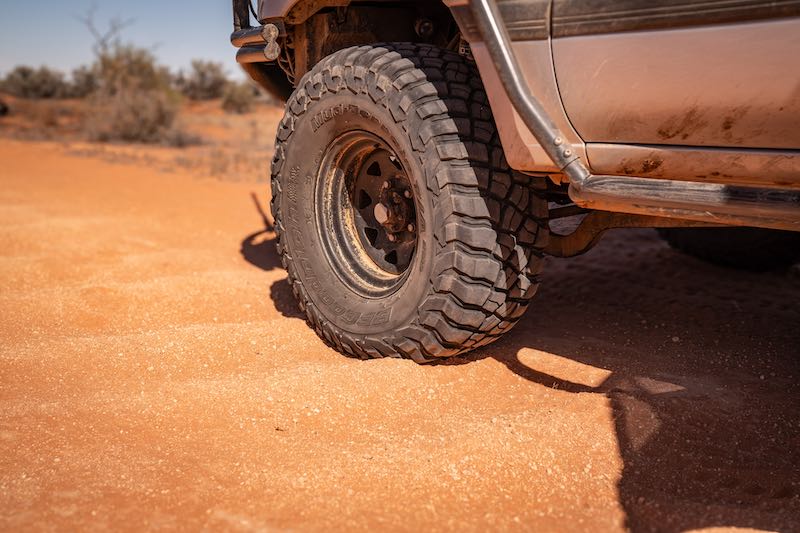
Pressure depends on what you are driving on, not just on the fact that it is corrugated. On remote gravel and fire trails I come down 20 to 30 percent off my on-road pressure, which puts most touring rigs somewhere around 28 to 32 psi. On sand I start at rim size in psi, so 17 psi on a 17 inch rim. Both are rough starting points. Vehicle weight, tyre size and tyre construction all move the number and you adjust from there.
There is a trap in this worth naming. Hard tyre plus fast hit is what breaks tyres. If you are going to use speed on corrugation, the pressure has to come down first. If you are not willing to air down, do not go fast.
The road has to allow it. Less rubber on the ground means longer braking and less grip. This is a technique for open, straight, well-sighted sections. It is not for blind crests, sandy corners, unfenced stock country or anywhere you might meet a road train.
Why my speed is not necessarily your speed
I often hear that 80 km/h is wrong. Keep in mind it is a rough guideline for me, it depends on the type of corrugation, and more importantly whether it can be done safely. The pushback usually comes from someone who has not tried it in their own vehicle. The actual exact speed was never the point. The point is that in most cases crawling corrugations is not a good idea. Every vehicle has a speed where it settles, and where that speed sits is mostly decided by things you chose when you built and set up your 4WD.
Tyre size
A bigger tyre makes an obstacle smaller. It cannot fall as far into a valley as a smaller tyre can. It bridges more of the gap and rides across the top of the corrugation instead of dropping all the way into the trough. That is why corrugation on 35s is easier to tolerate than on 31 inch tyres. Same track, same corrugation underneath, but less movement at the axle.
I run 315/75/16 Kenda MT on the Cruiser on a 16 inch rim, which gives me a good amount of sidewall. And the sidewall matters.
Sidewall
The tyre is the first part in the suspension system, which is why lower pressure is far more comfortable than higher pressure on rough terrain. If you have more sidewall you can lower the pressure more than with less. A 35 inch tyre on a 16 inch rim has a lot more sidewall than a 35 on an 18, and the two may require different speed for the same smoother ride. That is one of the reasons I run 16 inch wheels and not bigger.
If you do more road driving than bush driving I would recommend a 17 inch rim for the same tyre size, because it makes the on-road behaviour and cornering a bit better with less sidewall flex. Personally I think no 4WD should have bigger than an 18 inch rim unless you are running a 40 inch tyre.
Tyre type
A mud terrain has a much stiffer sidewall than an all terrain, so you need to run less pressure to do the same work. Two vehicles on the same size tyre at the same pressure can feel quite different if the tyres are different construction. Another benefit of the bigger tyre is that you have more rubber and more air in it, which gives you more room to air down before you risk sidewall damage, and it allows a bigger footprint.
Wheelbase
This one is less obvious and something you cannot change.
Your front and rear wheels do not hit the same corrugation at the same time. The back wheels arrive a moment later, and whether they land on the crest the front wheels have just left, or halfway down in the trough, is set by how long your vehicle is against how far apart that track's corrugations happen to be. It will be different for two vehicles with different wheelbase on the same track.
If both axles land together the whole car lifts and drops as one. If they land out of step it rocks nose to tail instead, and that is far and away the more unpleasant of the two.
The part worth knowing is that this does not change when you change speed. It is fixed by your wheelbase and by the spacing on that particular track. So two vehicles running side by side on the same corrugation can genuinely feel different, and both drivers are describing their own car accurately.
I have said for years that the correct speed depends on the vehicle and the wheelbase, and that for me it sits around 80 km/h if the track allows it. But the principle remains: faster is usually better on corrugation. I should also mention this works on a lot of Simpson Desert dunes which have the big scallops where a 4WD can rock like a boat. There are a few you cannot do with speed, but for the vast majority speed is better. Obviously you have to slow down before you crest and make sure there is no oncoming traffic.
What I actually do
I look for the speed where the vehicle settles rather than aiming at a number, because the spacing changes from track to track and even along the same track. On most outback corrugation that lands between 70 and 90 for me.
Below that, in the 30 to 50 band, everything shakes hard. That is where the damage gets done.
The rest is common sense. Ease off well before crests, corners and floodways. Do not brake and accelerate hard, for your own sake and for the track. And check your bolts at camp, because corrugation finds everything eventually, no matter how well you drive.
The short version
Corrugations form on their own above walking pace. Your suspension does not create them and driving slowly does not prevent them. The worst speed for your vehicle is the one that matches its natural bounce rate, which is a lot slower than most people assume.
Faster is genuinely easier on the vehicle, but only if the shocks can control the wheel and stay cool enough to keep doing it, the tyres are down, and you can see far enough ahead to justify it. Take any one of those away and the argument falls over.
Corrugation is one piece of remote travel. The Simpson Desert Travel Guide covers it properly, plus the rest of what you need for a desert crossing and general outback driving — 260 pages, PDF and EPUB.