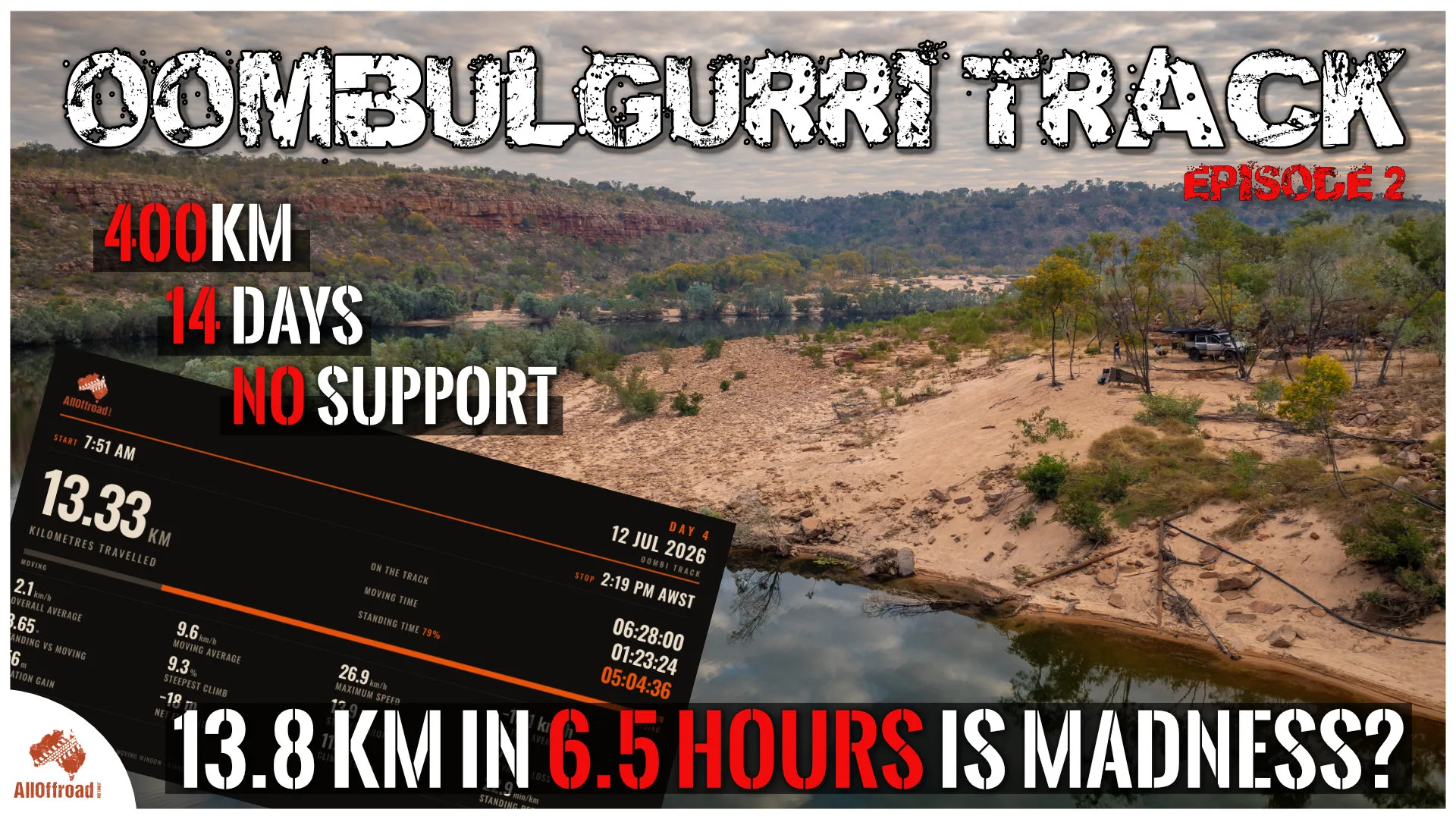
5.30 in the morning, the town cabin park in Kununurra, two nights there and today the trip properly begins. I'd learned a bit more about who I'd be sharing this track with. Two G-Wagens in the group, which I'm keen to see how they go, and a Mitsubishi Fuso Canter with a camper on the back — I'd only seen it drive past in Kununurra up to that point. I've done one desert trip before with a Canter and an Iveco that were sold to the group as recovery vehicles, capable of pulling anyone out. That didn't turn out to be the case, so I was curious to see how this one would handle the Oombulgurri Track.
We had our morning meeting with Nick from Koping in the Outback, our tour guide for the trip, and got introduced around. Nine cars in total, which I thought would make for an interesting group.
Day One: Wyndham and the Karunjie Track
Nick wasn't putting us on the Oombi track yet. The plan for day one was Wyndham and a few side tracks, then the Karunjie Track as a warm-up. His logic was simple — any vehicle that struggled here wasn't going to be ready for the Oombi.
Grotto Pool. First stop, about a kilometre off the Great Northern Highway on the way to Wyndham. Worth the short detour on its own. It's a deep pool at the base of a rocky gorge, about 36 kilometres out of Wyndham, sealed road right to the car park, then 144 concrete steps down to the water. Locally it's just called the Grotto. Supposedly over 100 metres deep, though I don't think anyone's actually confirmed that. In the wet season a waterfall drops about 120 metres into it. It's an important site for the local Aboriginal people going back a long way, and after European settlement it became a popular picnic and swimming spot for the Wyndham community — meatworks trucks were bringing people out here for a dip as far back as 1919. We didn't have time for a swim, unfortunately, but it's a picturesque spot.
Five Rivers Lookout. From there we headed up onto Wyndham's Bastion Range, about 360 metres above the town, where five rivers meet and flow out into Cambridge Gulf — the Ord, the Forrest, the King, the Durack and the Pentecost. This is also where Nick explained the only way out of the Oombi if something goes seriously wrong: an old barge landing just out of the community. Eight grand to hire the barge, and it comes back to drop your vehicle off. Otherwise you're flying parts and people in and out. Good thing to know before you commit to fourteen days with no support.
Welcome to Country. We met Colin Morgan next, and it was time for the smoking ceremony and welcome to country. Colin also introduced us to Warwick, who'd be our guide from the next day onward for the Oombulgurri Track itself. We got a few warnings too, about what the previous group had been through — one bloke hit a rock and put his automatic gearbox out on the track before this one. Good context for what we were about to get into.
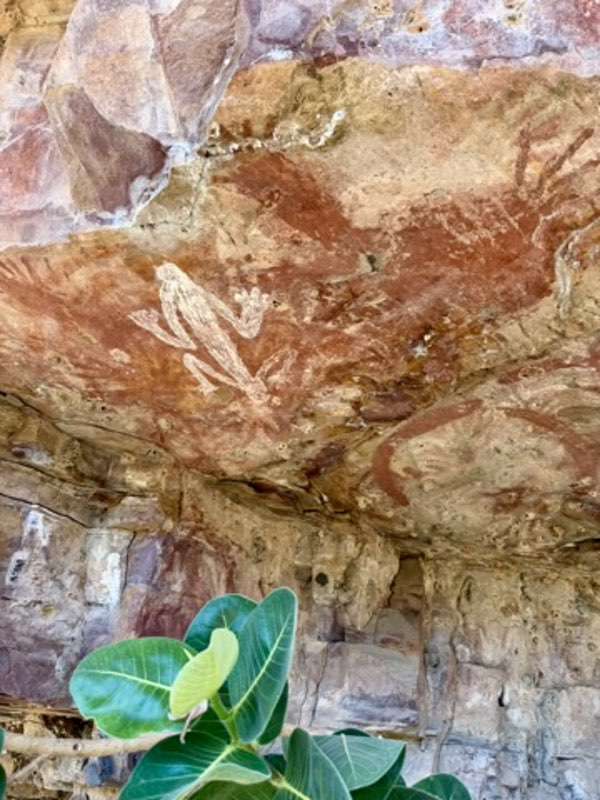
Moochalabra Aboriginal Art Site. Colin walked us through some of the rock art here and the history behind it.
Prison Boab Tree. Lunch stop with Colin, on the King River Road just out of Wyndham. This is a big hollow boab that police used as a lockup for Aboriginal prisoners being marched in for sentencing back in the 1890s. Accounts differ on exactly how — some say prisoners were held inside the hollow, others that they were chained outside while the police slept in the dry hollow themselves, which seems plausible because it's noticeably cooler inside than out. Boabs can live well over a thousand years. Some estimates put this one at 4,000 years old, which is unlikely, but a similar-sized tree in Derby has been carbon dated to 1,250 years, which is still remarkable. Makes you wonder what a tree like that has actually seen. Kaelan climbed up and grabbed us a boab fruit to try.
Before I get further into the day — thanks to GME for sponsoring this video. I've been running GME gear for over a decade, and my first PLB from them was bought over twelve years ago. These days I run three PLBs — one in each vehicle and one in my hiking pack — and I wouldn't head out this remote without one. In the Land Cruiser I run two fixed GME UHF radios, one for the group channel and one for the designated area channel, and the handhelds get constant use spotting on technical sections. This is gear I've genuinely relied on for the past 14 or 15 years, and if you're in the market for a UHF, a PLB, or a fixed radio, I'd recommend having a look at what GME offers.
Karunjie Track. Hot — I'd guess 35 to 40 degrees out there — and dusty. It's an old stock route, fairly rocky by reputation, and we were about to find out how the group's vehicles handled it. The Canter's height was clearing very little of the overhanging scrub, so it left its mark on the trees along the way. We stopped at an open plain with a waterhole Nick had caught good barramundi in before — first chance to wet a line, and the first real reminder that this is croc country, where you don't stand at the water's edge without thinking about it first. The Karunjie Track itself is an easy trek in the dry, but it gave the suspension a decent flex test, and so far I had nothing to complain about.
We came off the track back onto bitumen as the light started going, which meant a night drive into Home Valley Station with the light bars back on. The wind had completely died by then, so the dust hung around for ages, even after we'd set up camp.
Day Two: Home Valley Station
Coffee, then on the road by around eight, depending on when the traditional owners arrived. Everyone in the group made it through day one without issue, which was a good sign.
My camera storage setup — a lockable G-Box in the back — is working well. Everything's easily accessible without unstrapping gear from a plastic tub every time, which is how I used to run it.
I'd tried to get my alternator belts changed in Kununurra, but the wait for a mechanic was four weeks. Nick and Devo offered to do it for me at Home Valley instead, and I was glad they did — the alternator turned out to be tricky to loosen, but they got it sorted and the squealing stopped.
Home Valley Station used to be a cattle station, then a high-end resort — Nick's father apparently built a lot of the buildings there — before it went into Indigenous hands. We had dinner at the Dusty Bar the night before, which was better than expected.
Last fuel stop before the Oombulgurri Track. To get onto this track at all you need a traditional owner with you — it's invitation only, and Nick is considered family, which is how we had access. As he put it: if he breaks down, that's his problem; if any of the rest of us break down, that's his problem too. Fair warning to the group not to break down.
Onto the Oombulgurri Track
First crossing was fifty metres in. From here it's fourteen days, no support, no refuelling, the group stuck together on what's reputedly the hardest touring track in the country. The country up here is as good as it gets, and the history goes back over a century — including a massacre, which I'll get to.
I went into this trip a bit handicapped — bad tennis and golf elbow in my left arm for several months. I'd had a cortisone injection just before we left, which eased it for a while, though it was starting to wear off again.
The convoy stretched out early. The four-wheel drives kept a normal pace, but the Fuso Canter with the oversized camper couldn't clear the bush and kept hanging back. Elodie wasn't keen on bush-bashing, which is really what you have to do with a truck and camper that size on a track like this. Nick warned her, but hearing it and doing it are two different things. She and Alistair ended up cutting down a fair number of trees just to get the Canter through without scratching it, which meant frequent stops for the rest of us to wait. Elodie was also the least experienced driver in the group, and the truck was still fairly new to her.
The first mildly technical driving came early — a hill climb with a rocky, loose base. I hung back on day one to film rather than keep pace, which worked out fine at the group's speed. When the convoy hit a section with a mild side angle, Elodie wasn't comfortable running it without a spotter. Worth explaining why that side angle looks worse than it is: unlike a normal 4WD, the Canter has a flexible ladder chassis, so the cab can lean one way on the front axle while the camper leans the other way on the rear. Looks alarming if you're not used to it, but it actually keeps all the wheels on the ground, and wheels on the ground means traction. As long as the camper's well packed with the heavy gear low down, that side angle isn't a rollover risk. In the Land Cruiser the same section was barely noticeable.
I'll show a bit of footage that I think is a fair representation of what the Oombi is mostly made of — rock, not mud. Unlike what you'll see on 4WD247, most of this track is rock-based rather than the boggy stuff, partly because we were running it later in the year with less water around.
We were told the next hill climb was one of the harder ones and the first real obstacle on the track. First gear, low range, picked a line around the bigger boulders, and idled it up without drama. I'm still running Kenda Klever M/T tyres — the first proper long trip I've done on them — currently sitting a bit higher than normal at 24 psi rear, fully loaded, since I wasn't sure exactly what to expect and can always air down further from there. On a scale for day one, I'd call it a four — one or two hill climbs with loose rock, all crawlable on 35s, the side angles and tree clearance for the Canter being the more interesting parts. Otherwise a nice rocky drive, no mud, and I liked it.
The Durack, and the Oombulgurri Massacre
Heading toward the Durack, we passed through a place that's culturally significant for a heavier reason. This year marks the hundred-year anniversary of the Oombulgurri Massacre, which happened not far from here. As it was told to me: a young Aboriginal drover and his wife were working in the area when a white stockman assaulted the wife. When the husband found out, a fight followed — the stockman rode at him on horseback, and the husband speared him through the back, killing him. The husband and wife buried him in a shallow grave and fled toward the Oombulgurri mission, at a time when the church effectively sat above the law, much as it still does in some respects today. There are three known sites around here connected to what happened next. Other drovers found the body, the blood, the horse, and alerted the troopers in Wyndham. The troopers knew exactly who they were after and where to find him — and they didn't come out looking for one person. They came fully armed, with ammunition for days, and by the accounts passed down, shot dead anyone Aboriginal they came across on the way. I'll go into more of this when we reach Oombulgurri itself later in the series.
The next descent was probably the most technical section so far, if you want to call it that — some reasonable steps, a few diff-hanger moments, and loose rock on a fairly steep decline. First gear, low range, idled down. Warwick tried to spot me as far left as planned, but I didn't quite make the line and hung up on the rear spring hanger — the lowest point on a 70 Series Land Cruiser, and the passenger-side leaf spring hanger copped it. A reverse, a re-line, and a completely different approach got me through. Another rocky hill climb followed shortly after, similar terrain again.
Big shout out here to my sponsor, Kilos Gear — without them, a trip like this wouldn't be happening. The Oombi is an expensive one to run. I bought my first Kilos chair myself, well before any sponsorship, and now they support me with chairs, the Rover Camplight X, and the Back D series. Sponsored or not, it's currently my preferred lightweight chair and camp light setup, and I've used them every day on this trip.
- Kilos chairs & Rover Camplight X (affiliate link)
- My full Kilos Camp Chair review
- Kilos Rover Light X review
The Durack River crossing. We finally reached the Durack, which runs about 300 kilometres north from the Durack Range into Cambridge Gulf — the same river we'd looked down on from the Five Rivers Lookout in Wyndham. Surveyor John Pentecost named it in 1882 after Michael Durack, the first European to cross it. Down here it's a wide, rocky crossing — less water this late in the season, but that doesn't change the bed. Big boulders, shifted around after the wet, and slippery, as most of the group was about to find out.
Warwick went first and got hung up about halfway through in his stock 70 Series — no lockers, 33-inch tyres, the smallest vehicle in the group. A bit of shovelling and a few different lines and he got himself out under his own steam. Water levels were low enough that there was no risk of water ingress. Nick was next in his 200 Series, also struggled for traction and hung up somewhere at the rear, but the same approach — forward, back, try another line — got him through unassisted. Two down, seven to go. Devo followed in his 79 Series, double-locked but running without his lockers engaged, and got caught on the rear spring hangers much like Warwick had. That seemed to be the pattern for every 70 Series through the crossing — spring hanger clearance was part of the problem, but I think if Devo had switched his lockers on, it would have made the crossing considerably easier for him. The Fuso Canter on 37s went through without any trouble at all. The 200 Series with Bryce and Mark got through easily too, as did both G-Wagens after them.
I went next. Even the entry to the river was a boulder field, and the benefit of not going first is you get to watch every line before picking your own. I'd mapped out a line as far right as possible, and it paid off — a straight run through. Worth saying though, this was a low-risk crossing given the water levels. It would be a very different story with the river higher. Last through was a Troop Carrier, which also struggled before getting out on its own steam.
Camp on the Durack
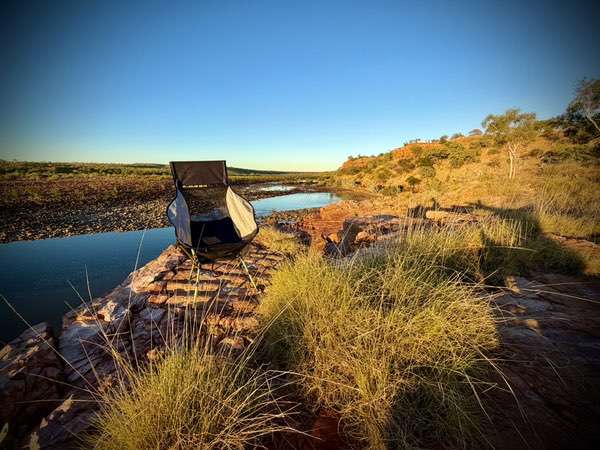
We rolled into camp close to 6pm, but the spot on top of the Durack River made up for the long day. With only about two hours of daylight left, I went straight down for a wash and found a freshwater hole upstream, well clear of anything saltwater. The rest of the group went fishing, Kaelan among them, and he landed his first barramundi with Warwick's help. Plenty of barra came through, but only two were legal size, and they went straight on the fire that evening. Hard to beat that, with a camp like that as the backdrop.
I track GPS and telemetry every day of a trip like this — kilometres covered, time actually moving, and standing time, which on the Oombi is mostly waiting on obstacles or waiting for the Canter to catch up.
That's the end of Part 1. Part 2 is Nulla Nulla, the rock garden, and Moon Pool.
The drive north is in Episode 1 and Sydney to Kununurra the Long Way North Part 2.
Gear on this trip
A few other things I'm running through this series that are worth a mention, even where they don't get airtime in every episode:
- iCheck Tyre Pressure Monitor (affiliate link) — live pressure and temperature on all four tyres, which matters on a track this hard on rubber.
- MorrFlate Air Systems — for airing down and back up quickly between rock, sand and formed road.
- OpenRoad awning — full review coming at the end of the series once it's been properly tested across the whole trip.
- MemoryMaps for All (affiliate link) — navigation and mapping for tracks like this where getting it wrong isn't a minor inconvenience.
If you're planning your own trip:
- Simpson Desert Travel Guide — for the Simpson rather than the Kimberley, but a solid resource if that's also on your list.
- Koping in the Outback — Nick's outfit, and the reason this trip was possible at all. Worth a look if you'd rather do a track like the Oombulgurri guided than plan it yourself.
Some of the links in this post are affiliate links — if you use them, I may earn a small commission at no extra cost to you. Not all of the links above are affiliate links. I only recommend gear and guides I actually use and trust on my own trips.