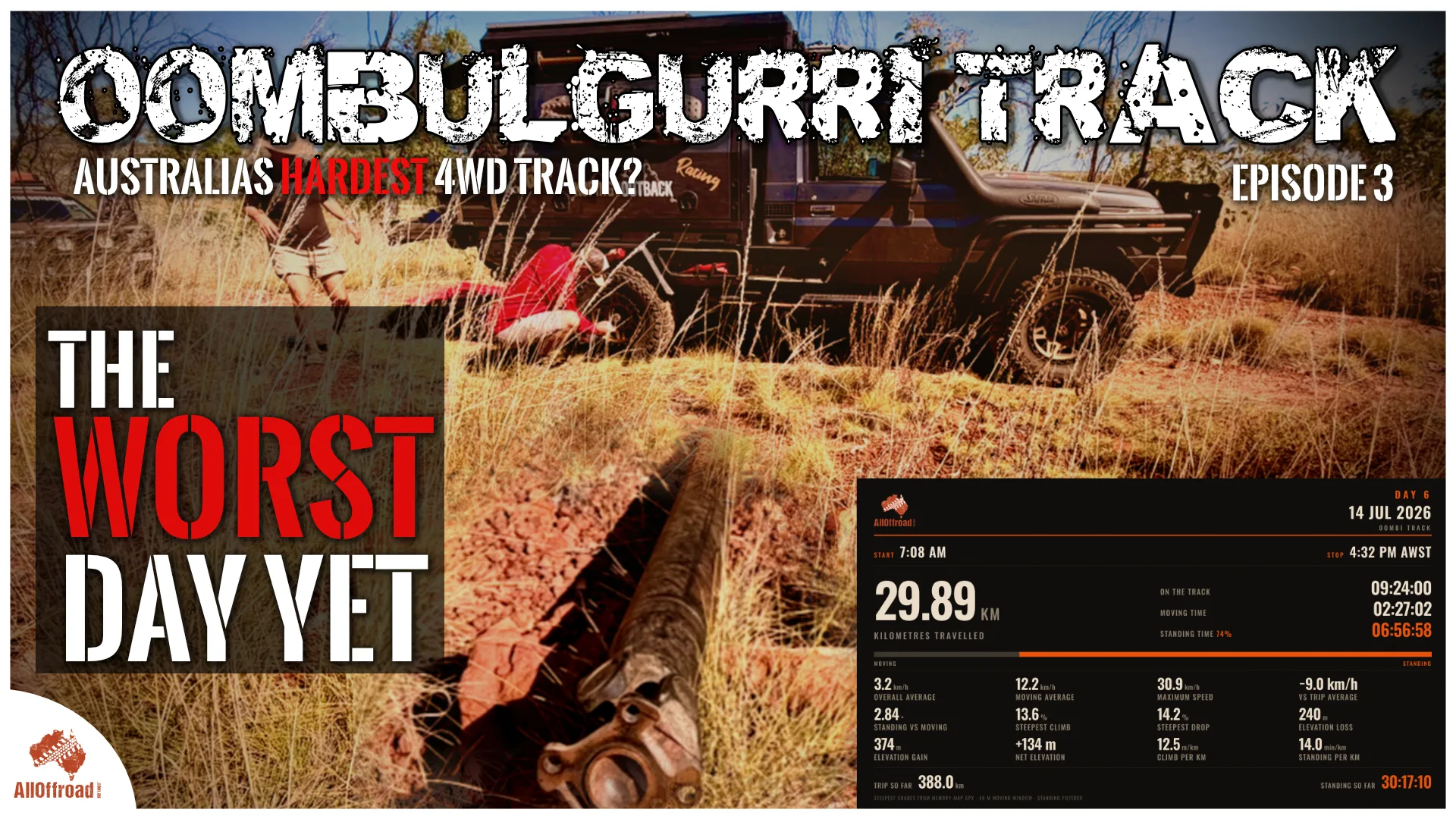
Thirteen kilometres. Six hours and twenty-eight minutes on the track. One hour twenty-three minutes actually moving, five hours and five minutes standing still. That's the Oombi Track for you.
The waiting time greatly outperformed the actual driving time, and this was one of the more interesting days.
Before getting into it — a shout-out to Kilos Gear, the sponsor of this series. The Kilos High Peak chair has replaced my Helinox as my most comfortable and lightweight camp chair, and I've been using it for well over a year and a half. The Rover X Light is part of my standard camp kit too — flexible enough for cooking, with different light modes from orange through to white and a small built-in night light.
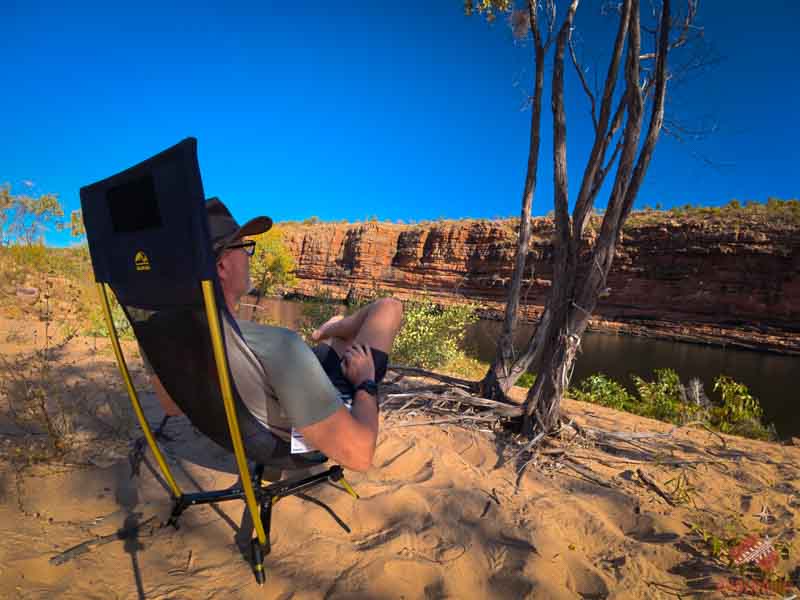
- Kilos chairs & Rover Camplight X (affiliate link)
- My full Kilos Camp Chair review
- Kilos Rover Light X review
The Canter problem
Over the years I've done very few trips where the group didn't have similar driving capability and similar four-wheel drives — especially on technical trips like this one. The Canter, as I feared from the beginning, took a lot longer for nearly everything. Constant track and tree clearing, and probably the less experienced drivers behind the wheel.
A group is only as fast as the slowest driver. Every hour or so we had to stop and wait for the Canter to catch up and consolidate the group. Those stops ran anywhere from twenty minutes to an hour and a half, and they added up over the day.
Most of the time I sat in front of the Canter but towards the back of the rest of the group, so I could stop, have a coffee, and film without holding anyone else up. All the waiting and starting and stopping meant a nagging sun and a later arrival in camp — more stress for me, because I still had to offload footage, set up camp, and get dinner on.
Nulla Nulla floodplains
We were apparently the first to cut this leg, through Nulla Nulla and its big floodplains. The grass was as high as a roof in parts. It flattened out fairly quickly, but you could hardly see the front car — and there were water courses running left and right that you had to watch for.
The OpenRoad awning came in handy through this stretch too — quick to set up and pack down, and I use it more for shade than anything else. A full review of it is coming later in the series.
The old Nulla Nulla community
Nobody lives at Nulla Nulla anymore. Just a few houses left. In the 1920s this was Nulla Nulla Station, Balanggarra country, sitting next to the Forrest River Mission. In May 1926 the station owner, Fred Hay, was killed by an Aboriginal man named Lumbia. Historical accounts say Lumbia acted after Hay sexually assaulted one of his wives. Over the weeks that followed, Aboriginal men, women and children were killed on this country — the Forrest River massacre.
The old community still doubles as a spare-parts compartment — there are old Cruisers there, emergency bedding, a whipper snipper, and an emergency phone.
I picked up a big stick through the front. We were quite lucky it didn't take out the front brake lines.
The hardest creek crossing
We'd been warned in the morning that this would probably be the hardest day, with a lot of rock scrambling. By this point we were seven hours in the seats, had spent around three hours waiting in the middle of the heat, and I was pretty knackered — my tendinitis was giving me grief.
We approached the last major creek crossing of the day, which turned out to be probably the most technical part of the entire trip. The riverbed was littered with big boulders of every size and shape. Devo and Nick were ahead of us and had already cleared it.
Next was the troopy. I did some spotting, but with a few different spotters offering different opinions on the approach and on locker engagement, and given this was Nick's tour and I was just a paying customer, I stepped back and let Nick take over.
Nick's approach versus mine
Nick has a different approach to four-wheel driving than I do. He uses more throttle and speed, which probably explains his reluctance to use lockers. More throttle with wheels up in the air does increase the chance of breaking something, especially with the front locked.
This was slow, technical terrain with not much steering involved — exactly where I'd use both lockers. My approach has worked for me across hundreds of technical drives on far harder terrain, over four different vehicles, without ever breaking an axle, diff, or any driveline component, despite using front and rear lockers thousands of times.
I've run a Jeep on Dana 60s, a Hilux on 37s with stock axles, and a Land Rover on Maxi Drive portals that were never designed for 37-inch tyres. I've never shied away from lockers on any of them, and I've gone over fifteen years without a breakage.
To be clear, I don't claim to know everything. As long as someone's approach works for them, I couldn't care less whether they run high tyre pressure or low, lockers or no lockers.
I did make an error in the rock field — my line was mapped out to stick right, but my concentration lapsed and my front went a metre too far left, catching a rock I couldn't see coming until I connected with it. I reversed out and realigned. With the front locker engaged, I had to drive while adjusting the steering, which gave the truck a bit of a funky angle getting through.
Moon Pool and a broken cable
By the time we got into camp the sun was going down. The Canter and Woz were well behind, still at the top of the hill, and decided to camp there for the night rather than push on in the dark.
Moon Pool was a beautiful campsite — a pity we arrived so late we couldn't enjoy it properly. It was the loudest camp of the whole trip, with plenty of nightlife and frogs, cane toads included. A group earlier in the year had been caught out at these camps by a flash flood that swept away several swags, so I made sure to camp up on the rocks rather than in the main creek bed, even with no rain forecast.
Leaving Moon Camp meant tackling a rock step to get back out of the creek bed — higher tyre pressure and more wheel spin meant more rocks flying, worth remembering if you're standing close to the track.
Then Woz's car died. No ignition, no lights, no dashboard. We had plenty of capable mechanics and electrical engineers in the group, and the fault turned out to be a broken cable to the alternator. Fixed, and back on the track with a bit of delay.
Worth a mention here too: GME gear, which I've relied on for over a decade. My first GME PLB was bought over twelve years ago — these days I run their newer MT620GR PLBs, one in each vehicle and one in my hiking pack. In the Land Cruiser I've got two fixed GME UHF radios, one for the group channel and one for the designated area channel, plus handheld units for spotting during technical driving. Gear I've genuinely depended on for fourteen or fifteen years of trips.
The sandy exit into Camera Pool
After an hour of lunch, including a good swim, it was time to leave. The exit out of the riverbed was a long river crossing followed by a very sandy, soft exit that caught out a few people needing several attempts. I was still running higher tyre pressure than I'd normally use for soft sand, but after watching others attempt it, I judged I'd be fine with a bit more momentum and good throttle control through the soft patches. That turned out to be correct.
Alistair in the Canter needed a second go but then did it with ease. Nick in the stretched 200 Series had more trouble than I expected but got through after a few tries.
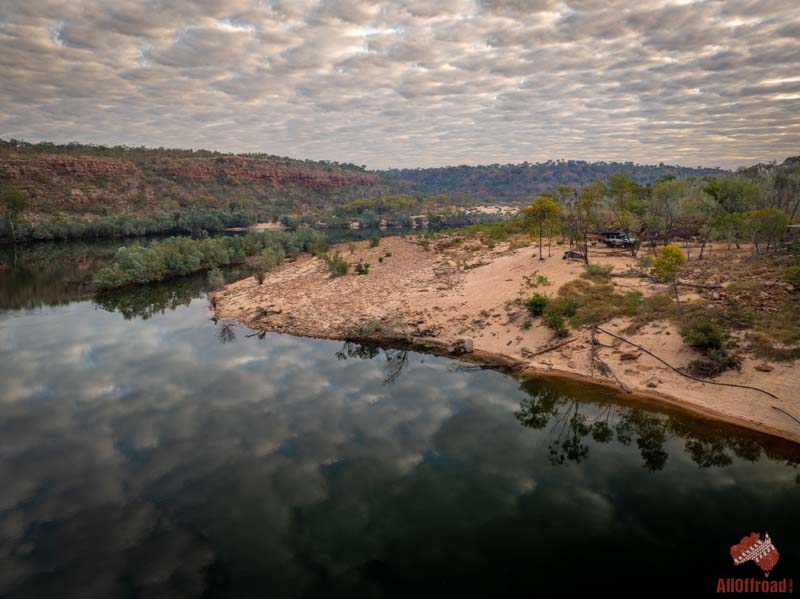
Camera Pool used to be the water supply for the small remote Indigenous community here — that's gone now, like so many others, though there are still remnants of the old pump station. No swimming — crocs. This was the first day since starting the Oombi Track that we actually arrived with time to spare, to enjoy the campsite rather than just set up and collapse.
Next episode: it gets harder for some people, and we visit Oombulgurri — the fourth abandoned town on the track, and one with a very eerie feel.
The first days on the track are in Part 1. The drive north is in Episode 1 and Sydney to Kununurra the Long Way North Part 2.
Gear on this trip
A few other things I'm running through this series that are worth a mention, even where they don't get airtime in every episode:
- iCheck Tyre Pressure Monitor (affiliate link) — live pressure and temperature on all four tyres, which matters on a track this hard on rubber.
- MorrFlate Air Systems — for airing down and back up quickly between rock, sand and formed road.
- OpenRoad awning — full review coming at the end of the series once it's been properly tested across the whole trip.
- MemoryMaps for All (affiliate link) — navigation and mapping for tracks like this where getting it wrong isn't a minor inconvenience.
If you're planning your own trip:
- Simpson Desert Travel Guide — for the Simpson rather than the Kimberley, but a solid resource if that's also on your list.
- Koping in the Outback — Nick's outfit, and the reason this trip was possible at all. Worth a look if you'd rather do a track like the Oombulgurri guided than plan it yourself.
Some of the links in this post are affiliate links — if you use them, I may earn a small commission at no extra cost to you. Not all of the links above are affiliate links. I only recommend gear and guides I actually use and trust on my own trips.